








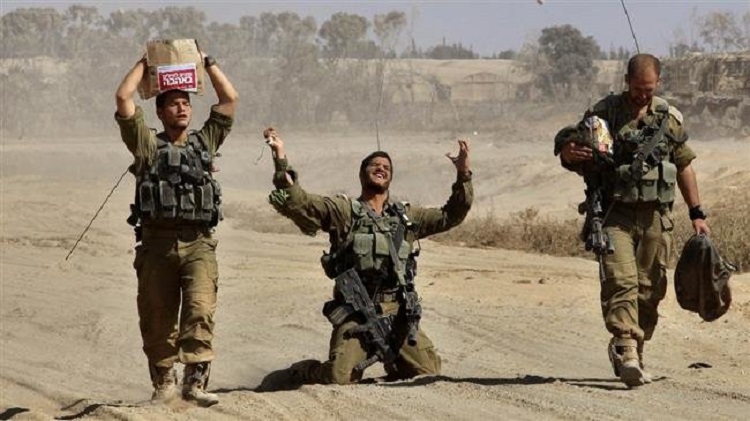
An army drained and in tatters facing Iranian strike power. It’s a Berezina!
Thus comes to an end the long-maintained myth of an invincible Israeli army, forged over decades and elevated to the status of a national dogma. This grand bluff is now cracking under the combined weight of Iranian strikes, as Iran has chosen to wage an unprecedented war of attrition against this paper giant. The growing strike capability of the Revolutionary Guards is such that yesterday, Thursday evening, alerts multiplied from the highest military and political levels of the Zionist entity, painting the picture of a country surrounded on all sides and gripped by an existential doubt about its ability to hold out. For the issue is no longer merely political: it is military, demographic, and strategic. Does the Zionist entity still have the means to sustain this war, fought simultaneously against Hamas in Gaza, against Hezbollah in the north, and against Iranian ballistic power which, since 2024, has demonstrated its ability to strike Israeli territory directly?
It was from the very heart of the security apparatus that the most alarming signal was sent. During a nighttime meeting of the security cabinet, the chief of staff of the occupation army, Lieutenant General Eyal Zamir, broke a taboo by publicly acknowledging the army’s limits. According to the Hebrew daily *Haaretz*, he reportedly stated bluntly that the army “is heading toward internal collapse.” “I am sounding ten alarm signals,” he reportedly added before the ministers, stressing that “the reservists will not hold” and that the army “now needs a conscription law.” *The Jerusalem Post* confirms the seriousness of the assessment, reporting that military sources describe “immense” concern over this shortage of soldiers, noting that no law has yet been adopted to significantly increase the conscription of ultra-Orthodox Jews, making the crisis structurally insoluble in the short term.
This human hemorrhage comes precisely at a time when the Iranians have never been more determined or better armed. In Gaza, despite eighteen months of an offensive described as genocidal by the International Court of Justice, Hamas continues to carry out urban guerrilla operations that tie down entire battalions in the rubble of a territory turned into a trap. In the north, the Lebanese Hezbollah, far from being neutralized by strikes from the occupation army, has, since early 2026, intensified its rocket and precision missile fire on Galilee and the Golan Heights, forcing the prolonged evacuation of tens of thousands of Israeli settlers from their homes and compelling the occupation army to maintain a costly defensive deployment in manpower along the northern border. As for Iran, the Islamic Republic demonstrated during its direct ballistic strikes of October 2024 that the Iron Dome and Arrow systems no longer guaranteed absolute invulnerability. Tehran now possesses an arsenal of hypersonic missiles and long-range drones capable of saturating Zionist defenses—a reality that forces the occupation army to spread its limited resources across a threat arc stretching thousands of kilometers.
It is this very dispersion that makes General Zamir’s warning so alarming. An army engaged in a prolonged war in Gaza, compelled to contain Hezbollah in the north, monitor the Iranian threat in the east, and divert forces to manage settler violence in the West Bank, cannot indefinitely rely on only a fraction of its population. Technological power and air superiority, however considerable, do not compensate for a lack of personnel on the ground. The myth of an all-powerful army collides with the exhaustion of reservists, the duration of the conflict, and the political impossibility of mobilizing the entire population. The chief of staff’s warning reflects a historic turning point: that of a crippled military apparatus forced to recognize that when human balances crack, the entire architecture of power falters—and with it the long-held certainty that Israel could wage all its wars without ever paying the price.












+ There are no comments
Add yours