


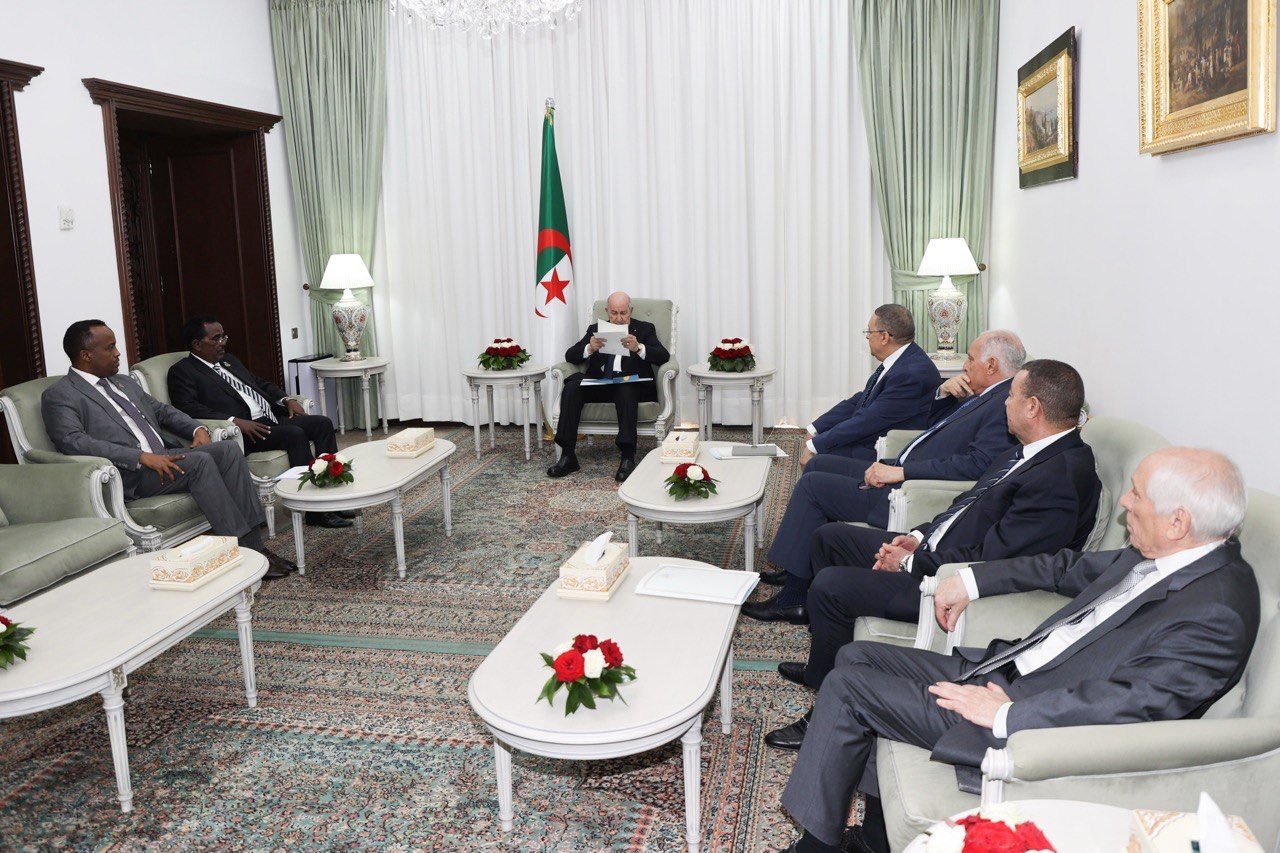
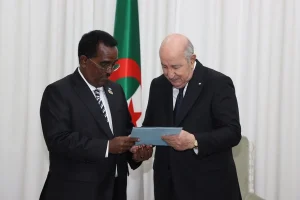
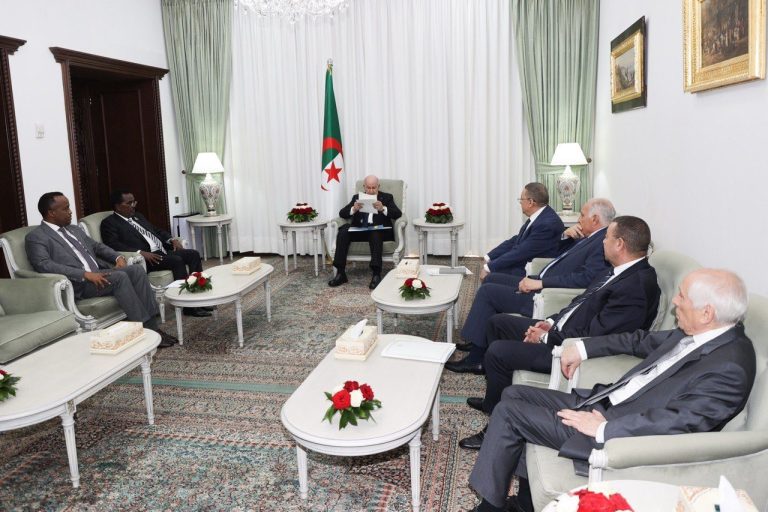
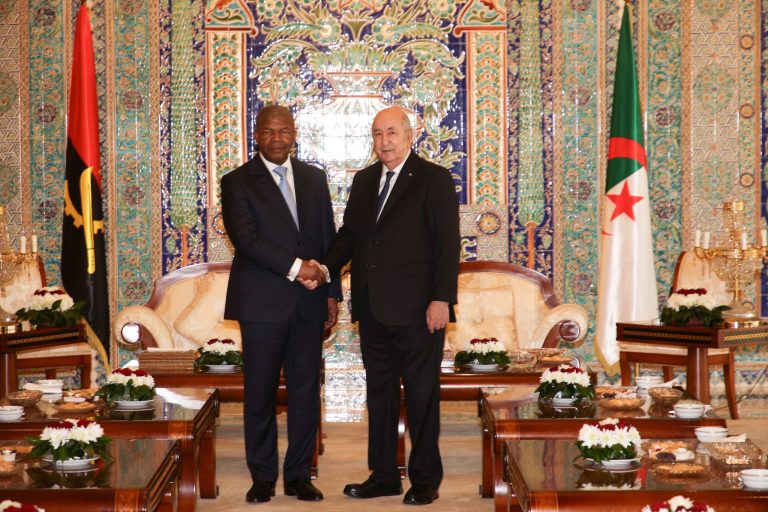
In the grand reception hall of the Algerian presidency on Wednesday, the handshake between President Abdelmadjid Tebboune and Ali Yusuf Hosh, Somalia’s Minister of Interior and Federal Affairs, spoke louder than words. Carrying a personal message from President Hassan Sheikh Mohamud, the envoy from Mogadishu was not on a mere courtesy visit. The presence alongside him of Minister of State in charge of the General Inspectorate of State Services Brahim Merad, Foreign Minister Ahmed Attaf, Interior Minister Saïd Sayoud, and presidential diplomatic adviser Amar Abba reflected the political significance of the meeting.
Somalia is currently facing one of the most serious crises in its recent history. On December 26, 2025, Israeli Prime Minister Benjamin Netanyahu crossed a red line by officially recognizing Somaliland as an independent state, making Israel the first — and so far the only — UN member state to take such a step, in total contradiction with the principles of international law. The decision sparked outrage across the Arab and African worlds and beyond.
Algeria was among the first countries to react. Twelve foreign ministers, including those of Algeria, Egypt, Turkey, Saudi Arabia, and Palestine, issued a joint statement condemning “in the strongest possible terms” the recognition, describing it as a blatant violation of the sovereignty, unity, and territorial integrity of the Federal Republic of Somalia.
The A3+ Group Mobilizes the Security Council
At the request of the A3+ group — composed of Algeria, Guyana, Sierra Leone, and Somalia — the United Nations Security Council was convened in an emergency session to examine the recognition, which has been widely denounced as illegal. The African Union, the Arab League, the Organization of Islamic Cooperation, and the Gulf Cooperation Council all condemned the Israeli move, warning that it could create “a dangerous precedent with considerable consequences for peace and stability across the entire continent.”
Somaliland’s geographical position, at the strategic crossroads of the Red Sea and the Gulf of Aden, gives this recognition a geostrategic dimension that extends far beyond Somalia alone. By recognizing the separatist region, the Zionist entity potentially secures a new foothold in the Horn of Africa, a crucial area for controlling international maritime routes and global trade.
Historical Ties Reaffirmed
Following the presidential meeting, Ali Yusuf Hosh did not hide his emotion. “We are pleased to visit today the People’s Democratic Republic of Algeria, this brotherly country which, throughout all historical stages, has remained a constant supporter of the Federal Republic of Somalia and a strategic partner with whom we share bonds of brotherhood, solidarity, and a common destiny,” he declared.
The Somali minister praised “Algeria’s honorable and consistent position — its leadership, government, and people — in support of Somalia’s unity, sovereignty, and stability, as well as its constructive role in supporting peace and development efforts.” These words are not merely ceremonial; they recall an Algerian diplomatic tradition forged since independence: unconditional support for peoples in struggle and scrupulous respect for the territorial integrity of states.
Relations between Algiers and Mogadishu, though marked by ups and downs amid regional turbulence, have strengthened considerably in recent years. “Relations between our two countries are currently experiencing an advanced phase of cooperation and exchanges, and we are pleased to witness the positive results of the agreements and memorandums of understanding signed between the two parties in multiple fields,” Ali Yusuf Hosh emphasized.
This cooperation extends beyond diplomacy alone. The Somali minister also praised Algeria’s initiative of granting scholarships to Somali students, describing it as “a real contribution to human development, skills training, and the strengthening of cultural and scientific partnership between the two countries.” It is an investment in youth that reflects a long-term vision for the partnership between the two nations.
Algeria, Guardian of International Law in Africa
This meeting confirms the role Algeria intends to play in defending the territorial integrity of African and Arab states against destabilization efforts. It is a role Algerian diplomacy had already fully embraced during its term on the UN Security Council (2024–2025), where it distinguished itself through its staunch defense of the principles of international law, particularly regarding the Palestinian issue.
For Algiers, Israel’s recognition of Somaliland fits into a broader strategy of fragmenting Arab and African states, aimed at weakening the front opposing the occupation of Palestine and Tel Aviv’s regional expansionism. By multiplying recognitions of separatist entities, the Hebrew state hopes to create precedents that could one day legitimize its own territorial annexations.
Algeria’s firm and consistent position serves as a reminder that peace and stability in Africa depend on respecting the borders inherited from decolonization and on non-interference in the internal affairs of sovereign states. It is a message addressed as much to the Zionist entity as to all those who, under the guise of realpolitik, might be tempted to sacrifice these principles on the altar of their geostrategic interests.




+ There are no comments
Add yours